
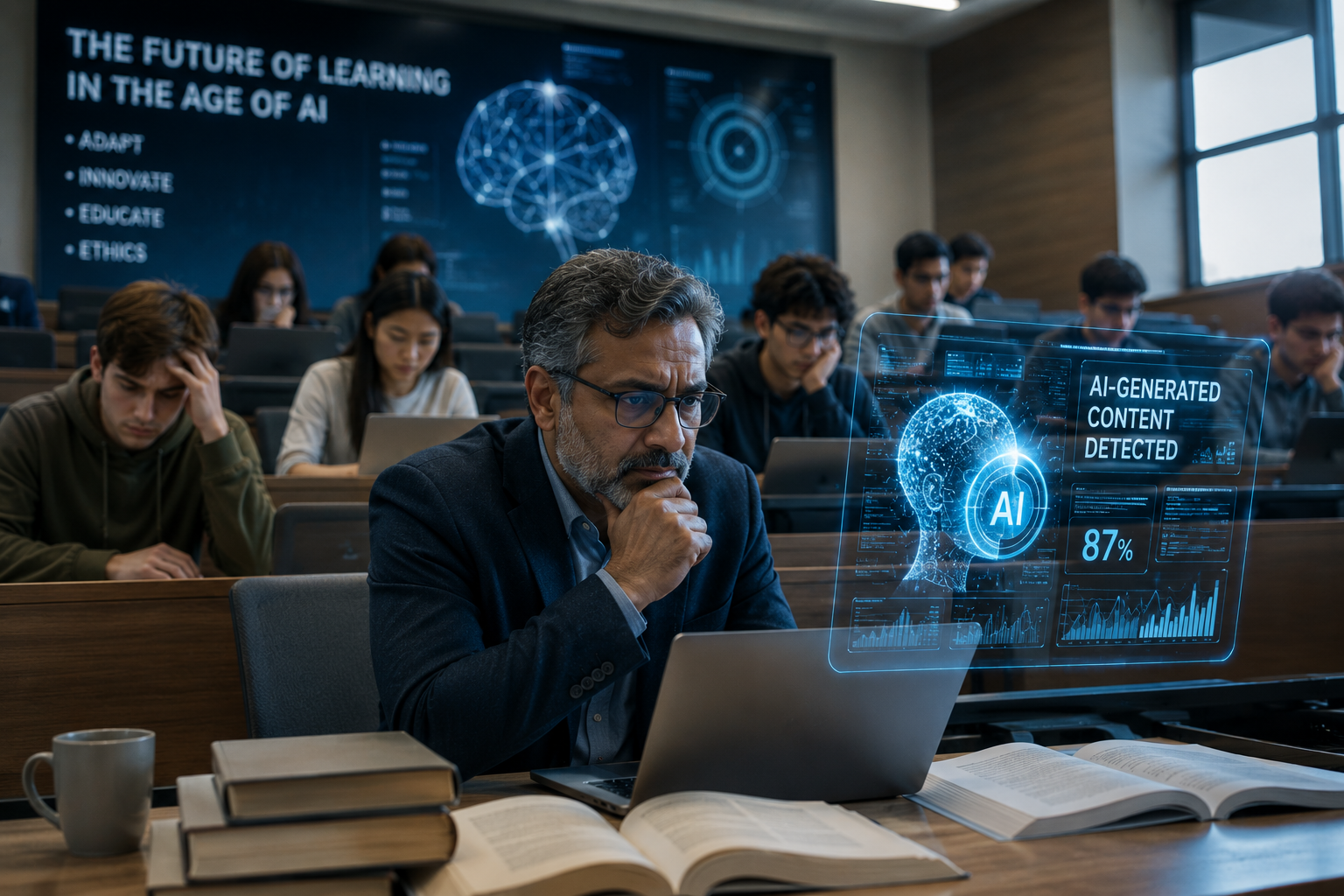
AI in education is rapidly changing classrooms, universities, and academic systems around the world. While artificial intelligence offers exciting opportunities for learning and research, many teachers and university faculty members are now facing difficult questions about ethics, academic quality, and the future of teaching itself.
A recent article from Dawn explored how educators are struggling to balance the benefits of AI with the growing problems it creates inside academic institutions.
For faculty members, the challenge is no longer theoretical. Artificial intelligence tools are already affecting assignments, classroom interaction, grading systems, and student learning habits.
This shift is creating both opportunity and uncertainty.
Why AI in Education Is Expanding So Quickly: AI in education
Artificial intelligence tools are spreading rapidly across schools and universities because they are easy to access and highly flexible.
Students now use AI systems for:
- Writing assistance
- Research support
- Summaries
- Language correction
- Coding help
- Study preparation
Faculty members are also experimenting with AI for lesson planning, content creation, and administrative tasks.
The speed of adoption has surprised many educators.
Only a few years ago, AI tools were viewed as experimental. Today, they are becoming part of everyday academic life.
Faculty Members Are Facing a Difficult Dilemma: AI in education
The biggest challenge for teachers is balance.
Many educators recognize that AI can improve productivity and support learning in useful ways. However, they also worry that overdependence on AI may weaken critical thinking, creativity, and genuine understanding.
This creates a serious dilemma.
If universities ignore AI completely, students may fall behind modern technological trends. But if institutions allow unrestricted AI use, academic standards may suffer.
Faculty members now find themselves caught between innovation and responsibility.
Academic Integrity Is Becoming Harder to Protect
One of the most discussed concerns involves academic honesty.
AI systems can generate essays, solve problems, summarize research, and even mimic human writing styles. This makes it increasingly difficult for teachers to determine how much work students completed independently.
As a result, universities are reconsidering traditional assignments and assessment methods.
Some educators fear that AI-generated work may reduce authentic learning experiences.
Traditional Teaching Methods Are Being Challenged: AI in education
Artificial intelligence is changing how students approach education.
Previously, students often relied heavily on textbooks, lectures, libraries, and classroom discussions. Now, AI systems can instantly provide explanations, summaries, and responses.
This shift is forcing faculty members to rethink teaching strategies.
Educators are beginning to ask:
- What skills matter most now?
- How should assignments evolve?
- What counts as original work?
- How can critical thinking be preserved?
- What role should AI play in classrooms?
These questions are becoming central to modern education debates.
Many Teachers Feel Unprepared for AI Changes: AI in education
Another major issue is preparedness.
Many faculty members did not receive formal training on artificial intelligence tools during their academic careers. As AI systems evolve rapidly, teachers often feel pressure to adapt quickly without enough institutional support.
This creates frustration in some universities.
Educators must now learn new technologies while continuing to manage teaching, grading, research, and administrative responsibilities.
For many faculty members, the pace of change feels overwhelming.
Technology Skills Are Becoming Essential
Digital literacy is no longer optional in education.
Faculty members increasingly need to understand:
- AI writing tools
- AI-assisted research
- Detection systems
- Ethical AI use
- Digital classroom strategies
Without proper training, many teachers worry they may struggle to maintain academic standards effectively.
Students and Faculty Often View AI Differently: AI in education
Students and educators sometimes approach AI from very different perspectives.
Many students see AI as a practical tool that saves time and improves efficiency. Faculty members, however, often focus more heavily on long-term learning outcomes and academic integrity.
This difference in viewpoint can create tension inside classrooms.
Some students believe AI use is simply part of modern education. Meanwhile, some faculty members worry students may become too dependent on automated systems.
Finding common ground will likely become increasingly important.
AI Could Also Improve Education in Positive Ways: AI in education
Despite the concerns, many educators acknowledge that AI also offers real benefits.
Artificial intelligence can support personalized learning, faster feedback, and improved accessibility for students with different learning needs.
Potential benefits include:
- Better study assistance
- Faster tutoring support
- Language translation
- Accessibility tools
- Personalized learning recommendations
- Administrative efficiency
Some teachers believe AI could eventually help educators spend more time focusing on mentorship and deeper classroom engagement.
AI May Help Reduce Repetitive Work
Faculty members often spend large amounts of time handling repetitive tasks.
AI systems may help reduce administrative burdens by assisting with scheduling, grading support, and content organization.
If implemented carefully, automation could improve efficiency without replacing human teaching entirely.
However, educators still want strong safeguards and ethical guidelines.
Universities Are Struggling to Create Clear Policies: AI in education
Many academic institutions are still trying to determine how AI should be regulated.
Some universities allow limited AI use under specific conditions. Others have introduced restrictions or updated academic integrity policies.
But there is no universal approach yet.
This uncertainty creates confusion for both teachers and students.
Faculty members often want clearer guidance from university leadership regarding acceptable AI use inside classrooms and research environments.
Critical Thinking Remains a Major Concern: AI in education
One of the deepest concerns surrounding AI in education is the potential loss of independent thinking.
Teachers worry that students may begin relying on AI-generated answers instead of developing their own reasoning and analysis skills.
Education is not only about producing answers quickly.
It is also about learning how to:
- Analyze information
- Solve problems independently
- Build arguments
- Think creatively
- Develop intellectual discipline
Faculty members fear these skills could weaken if students become overly dependent on AI systems.
Learning Requires Struggle and Practice
Many educators believe real learning involves effort.
Students often grow intellectually by struggling through difficult concepts, making mistakes, and improving gradually over time.
AI tools can sometimes shortcut that process.
While convenience is attractive, some faculty members worry students may lose valuable learning experiences if AI handles too much of the thinking process.
The Future of Education May Depend on Balance: AI in education
Artificial intelligence is unlikely to disappear from education.
Instead, universities will probably need to find balanced ways to integrate AI while still protecting academic quality and human learning.
This may require:
- Updated teaching methods
- New assessment systems
- Stronger digital literacy
- Ethical AI policies
- Better faculty training
The future of education may depend on how successfully institutions manage this transition.
Human Teachers Still Play a Vital Role
Even as AI tools grow more powerful, most educators believe human teachers remain essential.
Teachers provide far more than information.
They offer:
- Mentorship
- Emotional support
- Critical discussion
- Ethical guidance
- Classroom leadership
- Human understanding
Artificial intelligence may assist learning, but many faculty members believe it cannot fully replace meaningful human education.
Final Thoughts
AI in education is creating one of the most important academic debates of the modern era.
While artificial intelligence offers exciting opportunities for learning and efficiency, it also raises serious concerns about academic integrity, critical thinking, faculty preparedness, and the future role of teachers.
As highlighted in Dawn’s discussion, faculty members are now navigating a difficult balance between embracing innovation and protecting educational quality.
The future of education will likely involve AI in many forms. The real challenge is ensuring technology strengthens learning instead of weakening the human experience at the center of education.
Read Other Interesting news here: AI Workplace Bots
